

Division of Dermatology
Message from the Director
The Division of Dermatology is committed to delivering exemplary patient care and outstanding education. Our mission is to provide comprehensive, high-quality dermatologic care while training the next generation of dermatologists through a rigorous and clinically rich educational environment. Each member of our team works collaboratively to advance patient care and education, ensuring the highest standards of clinical excellence.
We provide a full spectrum of medical and surgical dermatologic services for diseases of the skin, hair, and nails within our outpatient facilities. Our services include general dermatology, medical dermatology, pediatric dermatology, dermatologic surgery including Mohs micrographic surgery, dermatopathology, and cosmetic dermatology.
Our Dermatology Residency Program offers exceptional clinical training for residents and medical students through broad exposure to diverse dermatologic conditions and procedural experience. This comprehensive training ensures that graduates develop the expertise and confidence needed to become well-rounded, highly competent dermatologists.
Through our continued growth, the Division of Dermatology strives to serve as a center of excellence in patient care and dermatologic education.
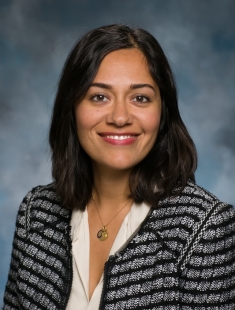
Bahar Firoz, MD
Clinical Director
Director of Mohs and Cosmetic Surgery


Clinical Services and Programs
Accordion Content
-
We offer comprehensive allergy patch testing to help identify potential triggers of allergic contact dermatitis. Patch testing can be particularly helpful for patients with persistent or unexplained rashes that may be related to contact with environmental allergens. Our clinic uses an expanded testing panel that evaluates approximately 50–80 common allergens associated with allergic contact dermatitis.
During the procedure, a series of allergens are applied to the patient’s back using adhesive patches. These patches remain in place for approximately 48 hours, after which they are removed and an initial reading is performed. A final reading is conducted about two days later to evaluate for delayed allergic reactions. Unlike skin prick testing typically performed in an allergist’s office, patch testing does not require needles or blood tests.
-
Our Cosmetic Dermatology program offers a range of advanced treatments designed to enhance and rejuvenate the skin. Using leading-edge aesthetic techniques, our physicians help patients achieve a refreshed, natural-looking appearance by addressing common cosmetic concerns such as fine lines, wrinkles, unwanted hair, visible veins, and uneven pigmentation.
Services offered include:
- Neuromodulator treatments (Botox®) and dermal fillers (including Restylane® and others)
- Chemical peels
- Resurfacing laser treatments for fine lines and wrinkles
- Laser-assisted hair removal
- Laser treatment for visible blood vessels
- Leg vein therapy
- Treatment of age spots and pigmentation concerns such as melasma
- Earlobe repair
- Platelet rich plasma
-
The Center for Dermatology provides a full range of dermatology services for adults and children. Our physicians offer expertise in medical and surgical dermatology, as well as in the study and treatment of skin cancer and common skin diseases including:
- Acne
- Contact dermatitis
- Rare skin diseases such as
- Blistering diseases
- Hair loss disorders
- Lupus
- Rosacea
- Psoriasis
- Warts
-
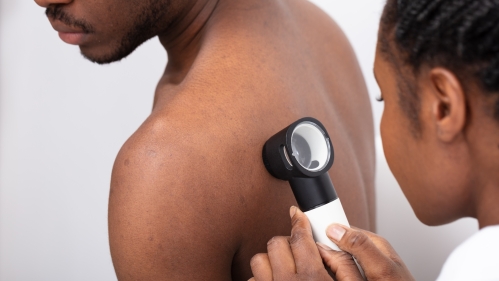
The Melanoma and Pigmented Lesion Center provides comprehensive evaluation and management of melanoma, pigmented lesions, and other concerning skin findings. Our specialists use advanced diagnostic techniques and evidence-based approaches to ensure accurate detection and the most effective treatment options for our patients. Our physicians have expertise in dermoscopy, a specialized technique that uses high-magnification imaging to evaluate skin lesions and improve the early detection and management of melanoma and other pigmented lesions.
Services offered include:
- Screening and management of nevi and melanoma
- Dermoscopy and digital image analysis for lesion evaluation
- Dermatopathology (microscopic and molecular evaluation of skin disease)
- Confocal microscopy (an advanced imaging technique that allows for non-invasive imaging of skin lesions)
Our team is committed to prevention, early detection, patient education, and ongoing monitoring for individuals with melanoma, atypical moles, and those at increased risk for skin cancer.
-
Mohs micrographic surgery is the most effective treatment for basal cell carcinoma and squamous cell carcinoma, the most common types of skin cancer, offering nearly 100 percent cure rate. It is considered the treatment of choice for skin cancers on the face and other cosmetically or functionally sensitive areas, as well as for recurrent or high-risk tumors.
Our Mohs surgeons specialize in this precise, tissue-sparing technique, which allows for the complete removal of cancer while preserving as much healthy skin as possible. During the procedure, the cancer is removed in stages and examined under the microscope in real time to ensure that all cancer cells have been eliminated. In many cases, treatment can be completed in a single visit and reconstruction of the affected area may be performed the same day.
-
Our Pediatric Dermatology Clinic provides specialized care for infants, children, and adolescents with a wide range of conditions affecting the skin, hair, and nails. We evaluate both common and complex dermatologic conditions in a child-friendly environment, working closely with families to provide thoughtful, individualized care. Appointments may be scheduled directly or through referral from a primary care physician or other specialist.
Conditions commonly evaluated in our clinic include:
- Acne
- Atopic dermatitis (eczema)
- Viral rashes and warts
- Contact dermatitis
- Birthmarks and vascular lesions (including hemangiomas)
- Psoriasis
- Hair loss disorders
- Skin growths and benign lesions
- Genodermatoses and other inherited skin disorders
We also perform select in-office procedures, including wart treatment, biopsies and removal of skin growths, and certain laser procedures when appropriate.
-
These treatments use controlled light-based therapies to manage a variety of skin conditions.
Phototherapy uses carefully measured doses of ultraviolet (UV) light to treat conditions such as psoriasis, vitiligo, severe eczema, and cutaneous T-cell lymphoma. Treatments are typically performed in our office two to three times per week using narrowband UVB or PUVA therapy, with patients standing in a specialized phototherapy booth.
Although dermatologists generally recommend minimizing unnecessary sun exposure, controlled UV light administered at specific therapeutic doses can provide significant anti-inflammatory benefits for certain skin diseases. This medical treatment differs from commercially available tanning devices, which are not recommended and should not be used to treat skin conditions. Phototherapy treatments are carefully tailored to each patient’s diagnosis, skin type, and response to therapy to ensure safe and effective care.
Photodynamic therapy is used to treat certain precancerous and sun-damaged skin lesions. During this procedure, a topical photosensitizing medication is applied to the affected skin. After an incubation period, the treated area is exposed to a specific wavelength of light that activates the medication. This reaction generates oxygen molecules that selectively destroy abnormal or rapidly dividing cells while minimizing damage to surrounding healthy tissue.
Surgeries & Procedures
Accordion Content
-
Platelet Rich Plasma (PRP) is a treatment that is used to accelerate healing. It is also used to regenerate hair loss. PRP is a three-step process in which blood is taken, processed, and then injected into the scalp.
For best results, consistent treatment is important. Treatments are performed roughly once a month for the first three to four months, and then every three to six months. Results can first be seen within two to three months.
-
Mohs surgery is a precise method of tumor removal developed by Dr. Frederic E. Mohs. It is the most advanced and effective treatment for the eradication of basal cell carcinoma and squamous cell carcinoma with nearly a 100 percent cure rate. The procedure involves removal of the entire skin cancer layer by layer, while leaving as much of the normal skin as possible. It is the treatment of choice for facial skin lesions and recurrent lesions elsewhere. Many types of skin cancers can be treated and reconstructed on the same day.
Dr. Firoz is a fellow of the American College of Mohs Surgery (ACMS) and leads the Mohs surgery team in our outpatient clinic facility.
-
Shave biopsy or “tangential excision” is a procedure which uses a sterile blade or a curved sterile razor blade to remove a skin surface growth off under local anesthesia. A “curette” does a similar task with a special scraping tool. These are often done to remove a small growth and confirm its nature by sending it for pathologic analysis.
-
Punch Biopsy is typically used by dermatologists to sample skin rashes or to remove small growths. After a local anesthetic is injected, a biopsy punch, which is basically a small (1 to 4 mm diameter) version of a cookie cutter, is used to cut out a cylindrical piece of skin. The hole may be closed with a suture and heals with minimal scarring.
-
Excisional Biopsy is the process of removing the entire skin growth with the use of a sterile scalpel. Local anesthesia is injected to the area before the tissue is removed and the wound is repaired using sterile sutures. The skin growth removed is then sent for pathology for diagnostic purposes.
-
ED&C is the scraping and burning of skin growths which is done for less serious skin cancers, pre-cancers and benign growths. A local anesthetic is injected, and then the abnormal tissue is scraped off with a curette. The area is then cauterized until bleeding stops. This may be repeated if the growth is cancerous. The wound will need to be dressed until it heals, and it usually leaves a small white mark after it heals.
-
Intralesional Injection is the direct placement of a medication into a problem skin area through a very fine needle. Most often a dilute solution of triamcinolone (Kenalog) is used. Acne cysts, keloid scars, alopecia, psoriasis and chronic forms of eczema may be treated this way.
-
Cryosurgery is frequently used by dermatologists to cause localized cell injury and destruction of skin lesions. Liquid nitrogen is sprayed on to the area of skin involved. Light freezing causes sloughing of the damaged tissue. It is commonly used for benign growths such as seborrheic keratoses and pre-cancerous lesions among other conditions.
-
Acne surgery involves the careful removal of individual acne lesions, such as comedones (blackheads) and pimples, using a sterile needle or small blade, followed by extraction of the keratin plug with a specialized tool. In addition to procedural treatments, we offer comprehensive medical management for active acne, including prescription therapies tailored to each patient’s needs. For patients with acne scarring, our clinic provides advanced cosmetic treatments designed to improve skin texture and restore a smoother appearance.